Chat can draft the register, but records must decide
For private operational or financial tools, chat is useful at the intake boundary. The official system still needs typed records, explicit evidence, and human review before anything becomes canonical.
Yesterday's useful material was a private register build: not a public recap of the product, but a clear architectural pattern worth writing down. The domain details are intentionally generalized here. The reusable lesson is how to let chat help with messy intake without letting it become the authority for a private ledger.
Registers attract ambiguous inputs. A user describes an event in natural language. A document contains dates, amounts, names, and exceptions. Some fields are missing. Some values are uncertain. It is tempting to let an assistant read the mess and write the final record directly.
That is the wrong boundary. The assistant can draft. The register has to decide.
The official view should be boring
A useful register is not a transcript of what someone said to an assistant. It is a set of typed records with status, version, source evidence, and deterministic inclusion rules. The official view should be reconstructable from explicit record IDs and versions, not from whichever text search or model answer looked plausible at report time.
That matters most when the register feeds accounting, audit, operations, compliance, or any other downstream process where drift is expensive. A draft can be uncertain. An official record should know why it exists.
Put chat in the intake lane
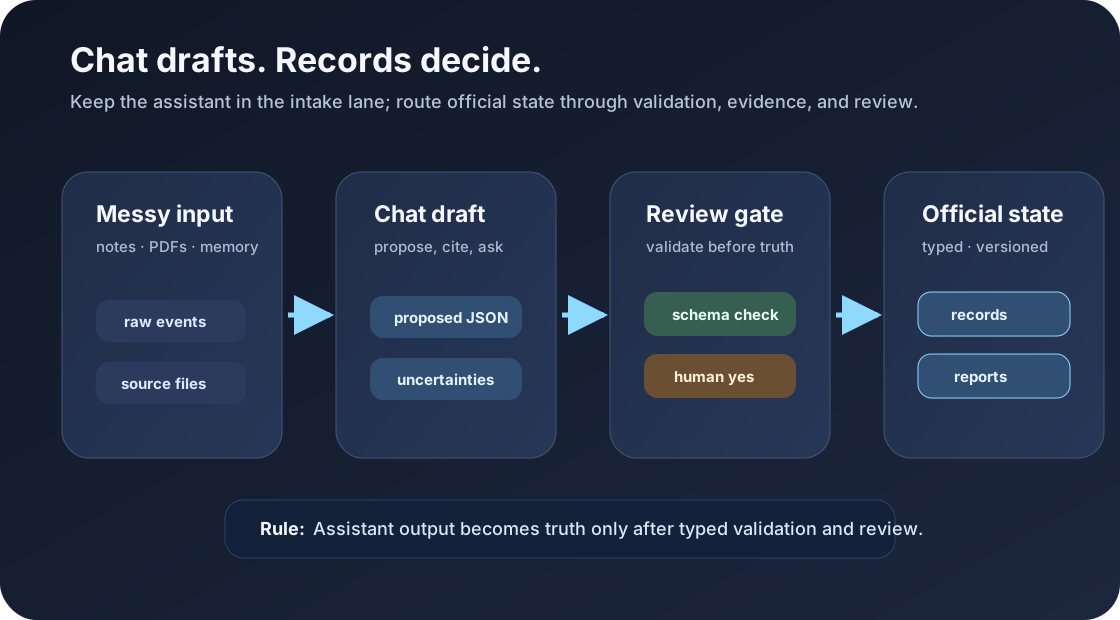
The boundary I trust has four layers:
- Messy input: natural-language notes, uploaded documents, old spreadsheets, and operator memory.
- Chat draft: extracted fields, open questions, proposed diffs, and evidence citations.
- Review gate: schema validation, status sanitization, missing-evidence checks, and a human decision.
- Official records: typed, versioned records that can feed holdings, ledgers, reports, exports, or dashboards deterministically.
This keeps the chat interface useful without granting it direct write authority over the canonical state.
Status is a security boundary
The simplest useful protection is also one of the easiest to skip: proposed records from chat should not be allowed to mark themselves as official. If an assistant proposes confirmed or reviewed, the product boundary should downgrade that to needs_user_review and record the reason.
That is not just a UI choice. It is a security and audit boundary. The source of truth should be able to say, “this value came from a draft, this field is uncertain, this evidence is missing, and this person approved the final version.”
Evidence beats confidence
For this kind of system, model confidence is less useful than traceable support. A proposal should carry the document IDs, file references, prior record IDs, and quoted field references that support it. If the evidence is absent, the draft can still be saved as a question, but it should not quietly graduate into the official register.
The same rule applies to reports. A generated report should not be “the assistant's summary of the register.” It should be a snapshot built from explicit included record IDs, versions, and evidence references. The assistant can help explain it; the report inputs should remain deterministic.
Separate setup tools from product runtime
There is another boundary I want to keep: operational tooling can configure assistants, experts, embeds, or workspace integrations, but the product runtime should not need admin MCP credentials or setup secrets. The app should consume a narrow embed or session contract, then route official writes through product-owned validation.
That gives operators room to improve the assistant without giving the assistant a back door into the ledger. It also makes failures clearer. If the chat embed is not configured, the app should show a manual intake path and an explicit unavailable state, not invent unofficial register changes.
The rule I am taking forward
The architecture is useful beyond private financial tools. It applies to incident registers, policy exception trackers, caregiver notes, asset inventories, and any workflow where AI helps turn messy input into structured operational memory.
Let chat reduce intake friction. Let typed records, evidence, and review decide what becomes true.
That is the difference between an assistant that helps maintain a system and an assistant that quietly becomes the system.