Make report exports prove what they contain
A report export should not just look printable. It should identify the exact records it includes, render from deterministic inputs, and carry a checksum that lets the operator prove whether the artifact changed.
Yesterday's useful lesson came from a small reporting slice: adding printable output to a private operational register. The implementation detail was HTML export. The reusable lesson is bigger: any report that may be reviewed, filed, compared, or handed to another person should be able to prove what it contains.
A report preview is not enough. A pretty page can drift away from the records that produced it, especially when the product keeps draft items, open questions, evidence links, and official records in the same workspace. The export needs a stable boundary around the facts it claims to summarize.
Start with an explicit snapshot
The pattern I trust is to make the report snapshot the unit of accountability. The snapshot should name the records it includes, the version or revision of each record, and the report options used to render the artifact. If a draft is excluded, that exclusion is part of the snapshot. If an open question is included as context, that choice is explicit too.
That design keeps the report from becoming a live query disguised as a document. Live views are useful for operators. Exported artifacts need firmer semantics: “this is the set of inputs that produced this output.”
Render multiple formats from the same canonical input
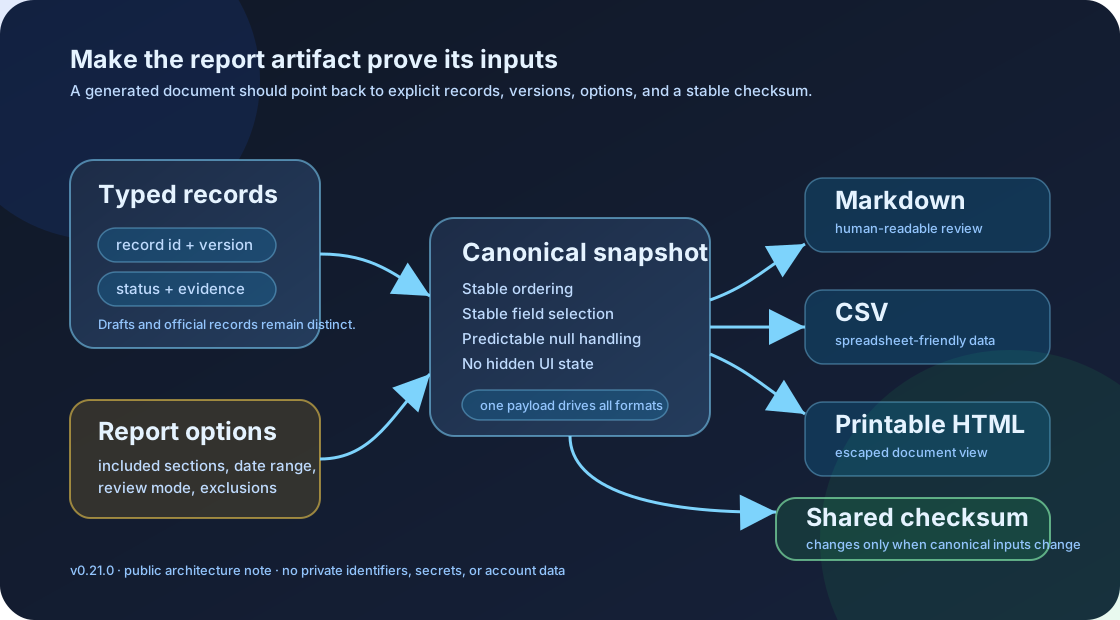
Once the snapshot is explicit, different export formats can share one source. Markdown can be readable for review. CSV can be convenient for spreadsheet work. Printable HTML can be filed or shared with someone who expects a document-like artifact. Those formats should not each decide what the report means.
The implementation should canonicalize the snapshot inputs before rendering and before hashing. That means stable ordering, stable field selection, predictable null handling, and no hidden dependence on the current UI state. If two exports claim to describe the same snapshot, they should be traceable back to the same canonical payload.
Checksums make drift visible
A checksum is not a security model by itself, but it is a useful operator affordance. It answers a simple question: did the inputs behind this report change?
That matters when reports are regenerated later, when someone asks why a number differs, or when a printable artifact is copied out of the app. The checksum gives the product and the reviewer a shared handle for the report's content. If the canonical inputs change, the checksum changes. If the same snapshot is rendered again, the checksum stays put.
Printable does not mean trusted HTML
Printable HTML is attractive because the browser already knows how to lay out a document. It also creates a boundary where record text might become markup if the export is careless. Report rendering should treat record values as data, escape them before they enter HTML, and keep styling separate from content.
That is especially important for private registers and workflow systems where operators can enter rich notes, names, questions, and copied text from other systems. The export should make that text visible, not executable.
The rule I am taking forward
The public-facing version of the lesson is simple: build exports as audit artifacts, not screenshots of state. Make the record set explicit. Render every format from the same canonical snapshot. Add a stable checksum. Escape printable HTML. Keep draft and official status boundaries visible.
A report export should be able to say: these inputs, these versions, this rendering, this checksum.
That rule applies beyond registers. It fits invoices, operational summaries, compliance packets, care plans, data-room exports, and any product surface where a generated document may become evidence outside the app.