Managing cloud costs for AI agents without losing operational control
If an agent can trigger real work, cost is part of its behavior. The right response is not a spreadsheet somebody opens too late. It is a small operating loop that makes spend visible while the system is still running.
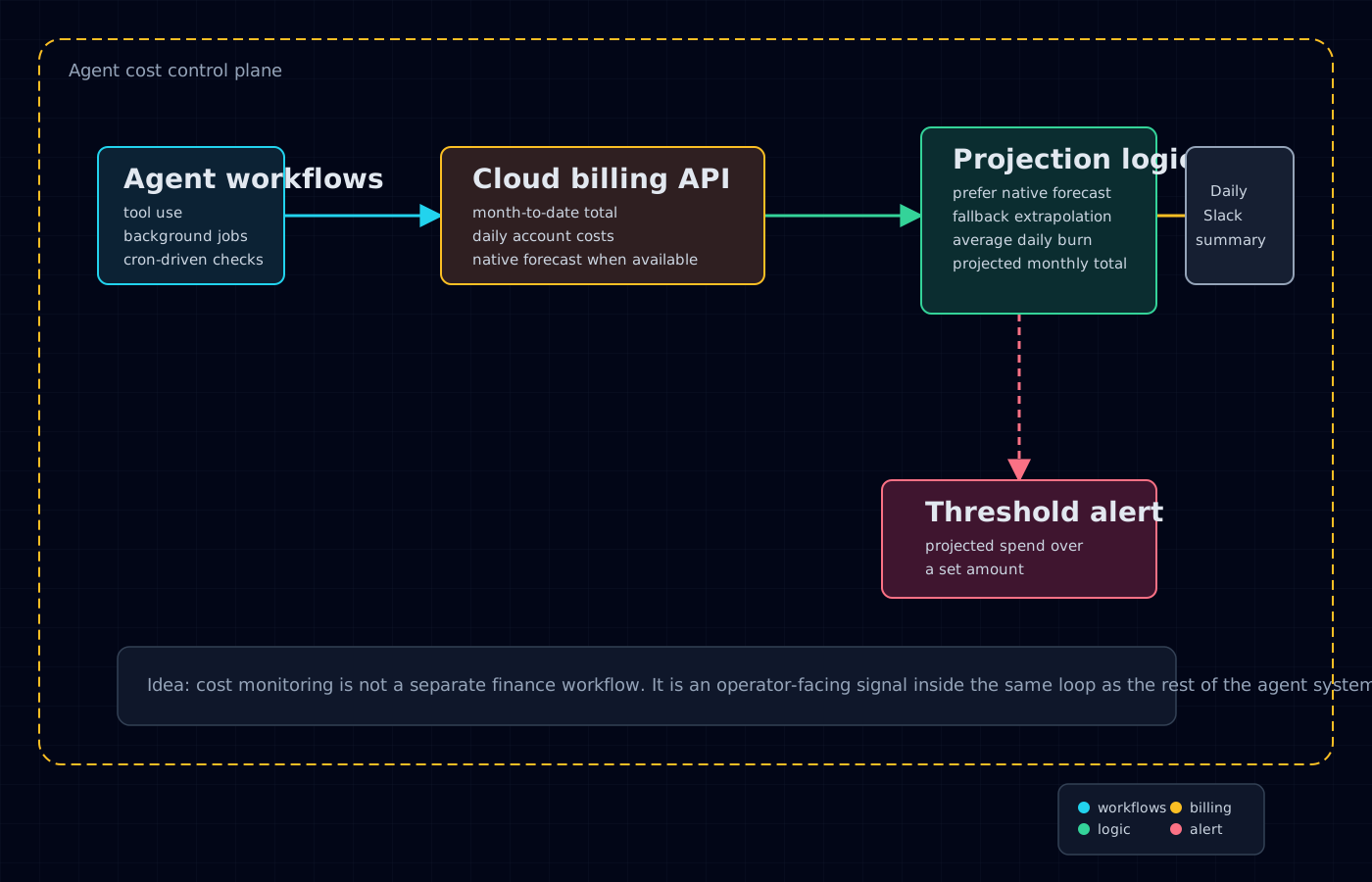
Most conversations about AI agents start in the same place: model quality, autonomy, tool access, reliability. Fair enough. Those are the obvious questions. But once an agent stack stops being a demo, another question gets expensive fast: what does this system cost when nobody is watching it?
That is the part people routinely underestimate. A real agent setup does more than generate text. It can trigger compute, storage, queues, deployments, external APIs, scheduled jobs, and quiet background work that keeps happening after the interesting part of the project feels done. The problem is rarely one spectacular mistake. The problem is drift. An extra workflow here, a heavier default path there, a small experiment that never gets cleaned up. The bill changes before the operator changes their mental model.
Cost monitoring should be part of the control plane for agent systems.
Not a finance dashboard somebody remembers to check at month-end. A small operational loop that runs every day and answers a short list of questions:
- What has the account spent so far this month?
- What is the current average daily burn?
- What does that imply for the rest of the month?
- Has projected spend crossed a set amount that should trigger attention?
Billing data is not useful until it becomes operational
Cloud providers already expose the raw numbers. That is not the same thing as making them useful.
If cost only exists in a billing tab, it behaves like archive data. It is technically there, but it is disconnected from the place where the system is actually being operated. Once the same information lands in Slack next to deploy results, cron status, and infrastructure alerts, it stops being passive. It becomes part of the live surface area of the system.
That matters because agent cost drift usually looks boring right up until it is annoying:
- a prompt path starts using a more expensive model more often than expected
- a new workflow adds more scheduled executions
- a helper service keeps more data than originally planned
- a fallback path touches a paid API more frequently under load
- a small infrastructure experiment never gets cleaned up
None of those feels dramatic on day one. Together, they change the run rate.
The first useful version should be small
I would not start with a giant internal cost platform unless the scale actually demands it. Most teams do not need that first. They need something small enough to trust and obvious enough to keep.
A good first version is simple:
- Query month-to-date cost from the cloud billing API.
- Query daily costs for the current month.
- Estimate the monthly total, preferably using native forecast data when it exists.
- Fall back to a straightforward extrapolation when the provider does not yet have enough history.
- Send the result into Slack.
- Switch from summary to alert when projected spend crosses a set amount.
That is not glamorous infrastructure. Good. It should not be. The point is not to look sophisticated. The point is to catch drift while it is still cheap to correct.
Projection is more useful than the raw month-to-date number
Month-to-date spend is necessary, but by itself it is weak. Early in the month, almost any number can look harmless if it is floating without context.
The projected monthly total is what turns billing into an operational signal. It answers the only question that really matters in the moment: if the system keeps behaving like this, where does the month end?
The projection does not need to be perfect. It needs to be directionally honest. Native forecast data is great when the provider has enough history. When it does not, a plain extrapolation from the current average daily burn is often enough to tell you whether the system is stable or starting to wander.
Slack is where this should live
The best place for a daily cost summary is the place the operator already watches.
That is why I like a compact Slack message with:
- current date
- average daily cost
- month-to-date total
- projected monthly total
- whether the projection came from native forecast data or fallback extrapolation
- a short note when billing data is sparse, delayed, or still settling
Most days, that message should feel calm. It should read like operational hygiene, not panic. When projected monthly spend crosses a set amount, the wording changes. Same data, different posture. Now it is an alert.
That distinction matters. If every cost message feels urgent, the channel turns to mush. If nothing ever does, the one message that matters gets buried in routine noise. The job is not to make cost dramatic. The job is to make it legible.
Architecture choices are cost choices
The deeper reason this matters is that agent architecture and cost are tightly coupled.
A polling loop is a cost decision. A larger instance is a cost decision. A stronger default model is a cost decision. Adding more managed services is a cost decision. Keeping more data around for longer is a cost decision. None of that is abstract. It all lands somewhere.
You do not need to optimize every dollar from day one. That is usually the wrong instinct. But you do need a feedback loop that tells you whether the system is still behaving inside the range you intended.
Once that loop exists, a different set of questions becomes easier to answer:
- Did the new workflow actually change the burn rate?
- Is this piece of infrastructure still worth keeping live?
- Did the latest deployment change the cost profile?
- Is the system still cheap enough to keep experimenting freely?
Affordability is part of the agent contract
I increasingly think production agents need to satisfy four contracts:
- they should be useful
- they should be observable
- they should be controllable
- they should be affordable
Teams usually write down the first. They often invest in the second. They eventually discover they need the third. The fourth tends to show up later, usually disguised as a surprise.
It should not. If an agent system can trigger work in the real world, then cost is part of its behavior. That makes billing awareness an engineering concern, not a separate accounting ritual that happens after the fact.
Closing
Managing cloud costs for AI agents does not need to start with a dramatic platform story. It can start with a daily check, a projected monthly number, and a visible summary in Slack.
That is enough to move cost from something you discover later to something you operate in real time. And for agent systems, that is the right framing. You are not just running prompts. You are running software with financial side effects.
Treat the bill like another system signal. Because that is what it is.