Private workflows need recovery surfaces
A private app is not launch-ready just because the happy path works. It needs visible recovery paths, recent activity, and support copy that helps the operator move without leaking internals.
Yesterday's useful lesson came from launch-hardening work on a private workflow product. The individual changes were small: legal and support pages, a read-only recent-activity surface, clearer recovery panels, and a practical direction for accountant-ready exports. The reusable lesson is that private systems need product surfaces for recovery, not just logged errors.
When a product handles sensitive records, the most dangerous failure mode is not always a crash. Sometimes it is a vague warning that leaves the owner guessing whether the data is gone, whether a session expired, whether the wrong workspace is selected, or whether an export can be trusted. That uncertainty pushes people toward screenshots, ad-hoc messages, and manual side channels.
Recovery is part of the product
Private workflows should assume ordinary operational failures: a browser session expires, an upload fails, an export cannot load its saved snapshot, or a workspace selector returns an empty state. Those failures should not expose tokens, raw record IDs, presigned URLs, or provider jargon. They should explain what the operator can do next.
That means designing recovery panels as first-class UI, not as catch-all error banners. A good panel can offer retry, session reset, scope selection, and a support path. It can also say what did not happen: for example, that the app has not changed official records just because a download failed.
Show safe recent activity
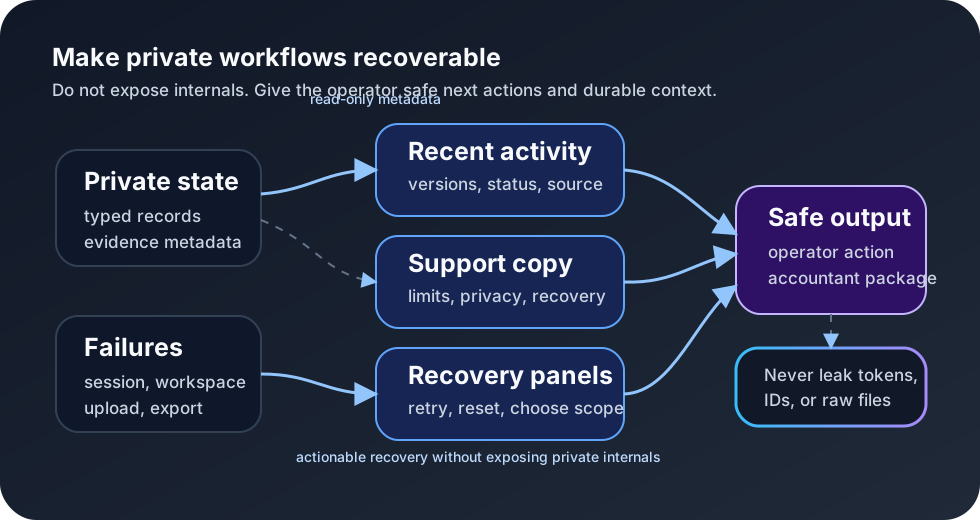
A recent-activity surface is not the same as a full audit log. It can still be valuable if it is honest about its boundary. Showing record type, status, version, updated time, and source metadata helps the owner answer “what changed recently?” without exposing document contents or file handles.
The important constraint is to summarize from versioned records, not from raw private payloads. The activity feed should be useful enough to orient the operator and constrained enough that it does not become a data leak disguised as observability.
Support copy should reduce panic
Support and recovery copy is not decoration. In a private financial, operational, or care workflow, the copy sets expectations: exports are private by default, drafts require review, generated reports are not professional advice, and failed uploads or downloads have specific recovery steps.
That copy belongs inside the product where the operator will need it, and it should be testable. If the product promises review gates, private exports, and session recovery, those promises should be covered by regression tests the same way route behavior and domain helpers are covered.
Handoff beats broad collaboration
The other launch-hardening lesson is scope restraint. When an outside reviewer needs information, the first useful feature is often not comments, roles, or collaborative mutation. It is a deterministic package or a narrow read-only handoff that shows exactly what the reviewer needs.
That keeps the source of truth inside the product. The owner can generate an accountant-ready package from saved report snapshots, include open questions as context, and avoid giving another person broad access to the working register. Collaboration can come later if it is truly needed. Safe handoff usually comes first.
The rule I am taking forward
Launch hardening is not only uptime and tests. For private workflow products, it is also the set of surfaces that help an operator recover calmly: support pages, recent activity, scoped error panels, and deterministic export packages.
Do not make the operator infer recovery from logs. Put the safe next action in the product.
That rule applies beyond registers. It fits document portals, internal approval tools, healthcare-adjacent workflows, compliance packet builders, and any product where private state must stay private while the human still needs to know what happened and what to do next.